

by Shane M Grizzle | Updated on July 26, 2023
In the previous blog, Fostering Success: Improving Teams through Team Charters, I drew a parallel between stepping into team leadership within a large organization and running a business. As a new team leader, your role transforms from an individual contributor to running a business, which is no small undertaking. While some may view this step as a mere pay raise or an opportunity to delegate responsibilities, true leaders are inspired by a passion for serving as force multipliers, empowering others, and thriving amidst complexities.
With a major in leadership studies, I am particularly passionate about the topic. I have gained team-level leadership experience as a Sergeant (i.e., Non-Commissioned Officer – NCO) in the United States Marine Corps, Light Armored Reconnaissance. Later, I held various leadership positions in corporate settings at the intersection of business and IT. And I have come to recognize the value and difficulty of effective team leadership. Just as NCOs are considered the backbone of the military, team leaders play a crucial and similar role in the corporate world. Your expertise in leading others and executing the mission is indispensable, as it comes with the challenge of tearing down barriers for team members’ growth while managing larger company objectives with limited time and resources.
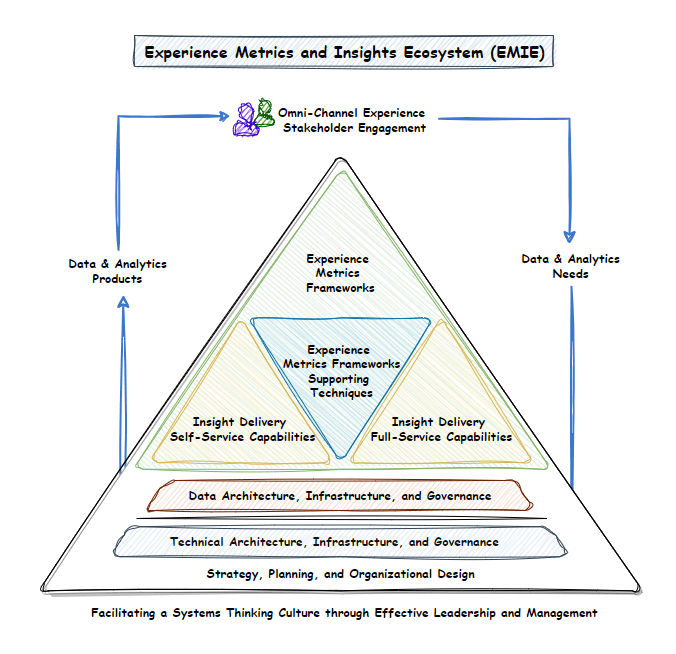
In the Experience Metrics and Insights Ecosystem (EMIE), leadership and management form the primary supporting element, and their alignment, from the lowest ranks to the c-suite, is crucial to achieving an Omni-Channel Experience. This point is especially true within large organizations, which is a focal point of this blog site. Embracing systems thinking, understanding how their domain fits within the larger ecosystem, and recognizing interconnections are vital for every leadership level, especially team-level leaders.
This blog aims to support new team leaders and those taking on leadership of new teams by providing a high-level overview of overarching themes to consider during the first 30 days. Subsequent blogs will expand on this topic to cover timeframes beyond 30 days and useful methods and tools. As a disclaimer, every team is unique; therefore, this overview does not encompass every scenario – leaders must remain flexible and agile.
Reference the EMIE framework diagram below, and learn more about the framework within my About Section and the blog, An Integrated Approach: Experience Metrics and Insights Ecosystem.
Challenge
New team leaders in large organizations face substantial challenges as they transition from an individual contributor role. Despite the indispensability of effective leadership, these aspiring leaders often do not have a comprehensive playbook to kickstart their success to help navigate ambiguity and complexities of team-level leadership.
Symptoms
- Unclear expectations hinder new leaders’ ability to grasp their roles, responsibilities, and appropriate delegation moments, resulting in uncertainty.
- Inadequate support and guidance result in new leaders feeling unprepared without a plan to navigate ambiguity within large organizations.
- Difficulty navigating ambiguity is overwhelming for new leaders, who may need help establishing a clear direction for their teams.
- Misalignment across team members regarding the overall purpose and objectives, leading to different priorities and conflicting efforts.
- Time management challenges impact new team leaders as they attempt to balance immediate demands and establish team-level strategic direction.
- Stress disrupts team leaders due to uncertainty and the need to prove themselves during the first 30 days, which inadvertently impacts their work-life harmony.
While these challenges are also likely symptoms of poor management above the team-level leader, they happen frequently in large companies. In this scenario, as a new team-level leader, you can play the victim or lead – it is your choice, and hopefully it is obvious.
Solution Consideration – The Hip-Pocket Guide (First 30 Days)
Before exploring the first 30 days, reading my blog, Fostering Success: Improving Teams through Team Charters, is beneficial. The team charter is a valuable tool and deliverable to target within the first 60 days. In the upcoming blog post, I will delve into the 30 to 60 days period, providing more insights for new team leaders or leaders of new teams. Stay tuned for additional details. In the meantime, keep the idea of the team charter in mind, as it will resurface as an essential tool of team leadership.
Your SMART Goal: As a new team leader, you must set clear goals for yourself during the first 30 days. Therefore, let’s start with an overarching SMART Goal (i.e., Specific, Measurable, Achievable, Relevant, and Time-Bound). You will be successful in 30 days if you achieve the following:
- Within 30 days of stepping into the team leadership role, identify and conduct one-on-one meetings with all team members, key partners, and key customers to gain in-depth insights into their strengths, challenges, and individual goals, fostering trust and rapport. Utilize the gathered information to develop a report, including short-term goals and strategies to align the team with the broader organizational objectives. Present this report to your manager to communicate your progress and strategic approach in shaping the team for success.
During your initial 30 days, your primary focus will be building relationships and understanding the operating environment. Subsequently, preparing a summary of your findings and outlining short-term next steps to present to your boss is essential. You need to align with your boss to solidify high-level expectations and goals. This effort should highlight how you are aligning the team with the broader organizational objectives. Depending on the situation, this effort can involve a discussion with your boss, a formal written report, or a presentation, ensuring effective communication of the insights you have gathered and your strategic approach to shaping the team’s direction.
As you begin your First 30 Day journey, consider the following areas and tools to help shape your effort:
You, the Leader: First, establish your leadership vision statement – what you aim to accomplish as an individual in a leadership role. This statement is not about your team; it inspires you as a leader, providing your foundation. Here’s an example:
- Personal Leadership Vision: My leadership vision is to foster a connected and collaborative environment among diverse individuals working together towards common goals, openly embracing opportunities to cultivate professional growth in one another.
Next, honestly identify your top three strengths and weaknesses, ensuring that your strengths do not overshadow or negate your weaknesses. Recognizing areas of improvement will enable you to seek team members and partners who have strengths where you are weak while also providing opportunities to leverage your strengths effectively in interactions with team members, key partners, and customers. Remember, true wisdom lies in acknowledging and addressing strengths and weaknesses, fostering a well-rounded and successful leadership approach.
Consider creating a diagram with four quadrants: Self, Career, Family, and Charity. Within each quadrant, document what holds significance to you. As you navigate the challenges of being a new team leader, this visual representation will serve as an anchor, guiding your priorities, time management, and overall well-being to achieve work-life harmony and avoid burnout.
Valuable tools, such as the Clifton Strengths, Thomas-Kilmann Conflict Mode (TKI) Instrument, and Big Five Personality, can assist in self-reflection and assessment. While this section does not aim to provide a comprehensive account, it emphasizes critical areas where attention is needed within your initial 30 days as a new team leader.
Your Workday: As a leader, your workday may encounter disruptions due to unplanned events, mainly while supporting a team in execution mode. However, being mindful of time management is crucial, as bad habits can quickly take hold and be challenging to regain control. To optimize your productivity, identify when you will most likely enter your flow state – optimal performance, engagement, and focused work without distractions. Monitor yourself over a few weeks to pinpoint this time and then intentionally reserve it for critical, high-value tasks, as this is where you can achieve remarkable results following the 80/20 rule (i.e., 20% of your efforts produce 80% of results).
Timeboxing is valuable as you collaborate with your team, partners, and customers. Allocate specific blocks of time on your calendar for these interactions and self-reflection, being deliberate about how you spend your time. For example, set aside 30 minutes in the morning for email, an hour for your flow state, followed by an hour dedicated to your team, and two hours for open office hours (i.e., anything goes). Taking ownership of your calendar and safeguarding your time is essential. Also, remember to include a lunch break to recharge as a leader, recognizing that it is okay to step away, as the work will continue, and prioritizing your health and well-being is vital.
Your Network: As you identify your partners and internal customers, documenting the relationships through context diagrams and network maps can be highly beneficial. A context diagram provides an overview of how your organization collaborates with various entities within the company. For instance, if you are responsible for Self-Service Insight Delivery for Omni-Channel Experiences, a context diagram can help visualize and map out the connections in terms of inputs and outputs, illustrating what you provide to these entities and what they provide to you (e.g., customers providing requirements, and you providing dashboards).
On the other hand, a network map visually represents connections between individuals or departments, allowing you to identify key influencers and areas for enhancing collaboration. In large organizations with numerous players, it is crucial to locate network brokers who can help accelerate your team’s mission and collaborate with you to develop solutions. Investing time with these individuals fosters mutual relationships, offering free advertisement for your team and excellent referrals to other helpful contacts. You might be a network broker as a team leader, but proactively identifying others and making time for them is equally vital.
Final Thoughts – Operational Efficiencies
Building seamless Omni-Channel Experiences in large organizations involves collaboration and alignment among numerous stakeholders. The team-level leader is at the core of this complex network, serving as the organization’s backbone. These influential leaders embrace systems thinking and work diligently to align their teams with others, vertically and horizontally, towards shared objectives.
Stepping into the role of a new team leader in such an environment comes with its unique challenges. Transitioning from an individual contributor to running your own “business” within the organization requires careful navigation. This blog sheds light on the complexities new team leaders may face in their first 30 days, stressing the importance of building relationships with your team, partners, and internal customers.
The Experience Metrics and Insights Ecosystem (EMIE) framework emphasizes the importance of strong leadership as a foundational element. While this blog provides critical considerations for the initial 30 days, it’s only the beginning of a new team leader journey. Stay tuned for upcoming blogs that expand on the hip-pocket guide, exploring timeframes beyond 30 days. This extension aims to empower new team leaders with the knowledge and tools to effectively overcome challenges and lead their teams.
Remember, operational efficiencies are the key to unlocking success, and it all starts with you – the new team leader.


 Shane M Grizzle
Leave a reply to Keto Queen Recipes Cancel reply