

by Shane M Grizzle | Updated on November 21, 2023
Previous blog articles addressed leadership and management, emphasizing the significance of effective team-level leaders. They also highlighted omni-channel stakeholder engagement and introduced the “Experience Metrics Tree” as a tool that complements and is a variation of KPI trees. These articles revealed the complexity of the organizational environment responsible for building seamless omni-channel experiences.
The complexities can create issues exacerbated by organizational silos, communication breakdowns, competing priorities, and more. Consequently, these issues manifest within the output of the environment – a cumbersome customer journey across channels (e.g., mobile, in-person). Recognizing this, embracing a systems thinking culture becomes necessary.
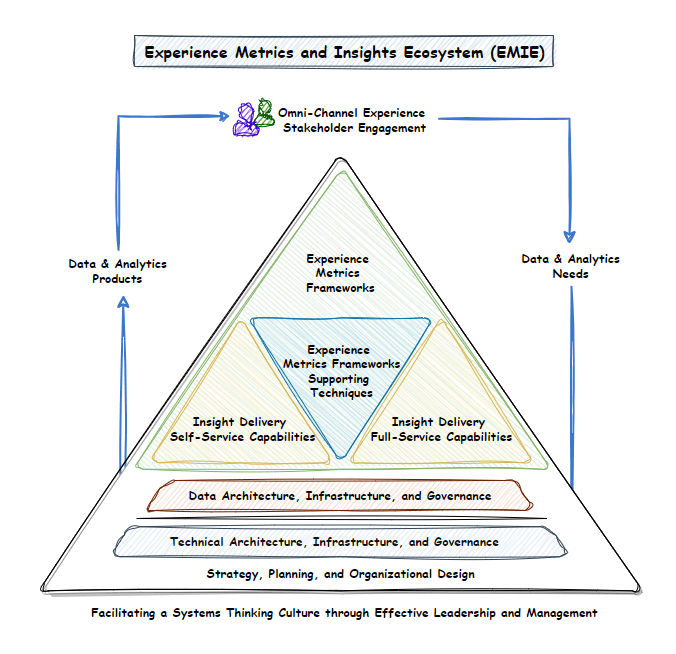
At the heart of the Experience Metrics and Insight Ecosystem (EMIE) lies the foundation of facilitating a systems-thinking culture through effective leadership and management. Leaders play a pivotal role in fostering cross-pollination of knowledge and resources, promoting collaboration across diverse teams (e.g., engineering, product), and aligning goals, key performance indicators, analysis efforts, and other activities. Their role better positions them to build an understanding and advocate the needs of various systems holistically. This article will highlight the importance of systems thinking while acknowledging other thinking styles.
Recognizing Thinking Styles
While the EMIE highlights the importance of systems thinking, it’s equally important to recognize other thinking styles, such as critical thinking.
Individuals often employ multiple thinking styles simultaneously. For example, someone committed to enhancing the user experience in a specific workflow may incorporate critical thinking, combining analytical and creative styles. Analytical thinking breaks down the workflow’s complexities and examines individual components. In contrast, creative thinking helps develop new ideas and original solutions. This dual approach helps the individual explore various solutions to improve conversion for the specific workflow. These styles are important and serve a purpose.
Various thinking styles and combinations play an essential role in problem-solving within a system. While each thinking style contributes its strengths, the EMIE emphasizes systems thinking. This emphasis stems from recognizing the importance of comprehending the system as a whole and its interconnections that need harmony, which is critical for delivering a seamless omni-channel experience. While the EMIE emphasizes systems thinking, it’s important to understand that this emphasis does not discount the importance of other thinking styles and how they are leveraged to problem-solve within the ecosystem.
Systems Thinking
When seeking a solution to a problem in one area, it’s important to consider the broader impact of proposed changes on other elements within the system. In the previously mentioned example, the focus is on a specific workflow. Questions arise: What factors influenced the decision to pursue these changes? What other teams are impacted by the suggested changes? How will the proposed alterations affect the workflow and the overall customer journey? Was the analysis confined solely to the workflow, or were external factors such as market conditions, seasonality, and other channels considered?…
Systems thinking is leveraged to address complex problems by analyzing individual components and how they are interconnected within the broader system and across systems. Within the EMIE, there are many systems with interdependencies. Likewise, the customer journey is a system with numerous interdependencies for even the simplest business models.
The EMIE and Systems Thinking
In systems thinking, a system is a group of interconnected components working towards the same desired outcome.
There are many systems associated with building omni-channel experiences within large organizations. Some examples are as follows:
- The EMIE functions as a system of inputs and outputs designed to shape and refine omni-channel experiences by focusing on objective decision-making. This system includes a complex network of relationships incorporating diverse expertise and activities. These activities are all geared towards establishing and leveraging metrics frameworks. The purpose is to instill cohesion across a complex organizational landscape, ensuring that efforts align to deliver a seamless customer experience across multiple channels.
- The customer journey is a comprehensive system that relies on various workflows and interactions. This system typically extends across multiple channels, such as mobile and in-person, and encompasses many activities to acquire new customers and retain existing ones. These activities, workflows, and interactions are interconnected. The success or failure of an attempt to retain an existing customer can influence acquiring new customers and vice versa.
- Metrics within the EMIE framework is a system. Just like the customer journey is a system, the metrics we use to understand this system are inherently interconnected, or at least should be to some degree. Each component has its metrics, akin to levers. Much like levers enable control or influence over a physical system, metrics provide a means to understand, measure, and adjust the various components of a system to achieve desired outcomes. However, the outcomes of one component can have a ripple effect on another. For instance, consider the goal of transitioning simple transaction handling from a call center to the digital realm. In this scenario, if your company measures the Average Handle Time (AHT) for the call center, this shift may increase AHT. Now, the call center is primarily handling complex cases, impacting the overall dynamics of AHT compared to a combination of complex and simple transactions.
These examples help illustrate the complex ecosystem where many systems interplay to shape omni-channel experiences. Beyond these illustrations, the landscape includes other systems governing design, engineering, and data management. Systems related to employee training and technology infrastructure also play pivotal roles, adding layers of complexity to crafting seamless omni-channel experiences.
Final Thoughts – Operational Efficiencies
The EMIE stresses the importance of facilitating a systems-thinking culture through effective leadership and management. Leaders accountable and responsible for influencing the creation, enhancement, and optimization of omni-channel experiences must understand and advocate for the needs of various systems. There are many systems within this domain in large organizations.
However, the EMIE does not discount the value of diverse thinking styles. Individuals naturally leverage various thinking styles concurrently throughout their workday. And this is okay. There is a time and place for everything, so we shouldn’t stifle one type of thinking for another where positive outcomes are prominent. It’s important to clarify that the EMIE doesn’t dismiss other thinking styles but emphasizes the significance of embracing a systems-thinking approach.
Whether starting this journey as a newcomer or refining your strategies as a seasoned professional, what are some of the systems associated with building your company’s omni-channel experiences? What are the components of those systems, and how do they interconnect? In the EMIE context, what metrics frameworks and techniques does your company utilize? Do those metrics create an understanding of individual components and the system holistically?
 Shane M Grizzle
Leave a comment