

by Shane M Grizzle | Updated on September 22, 2023
The omnichannel experience should encompass a seamless journey across various interactions and channels throughout a customer’s lifecycle. This end-to-end journey must be interconnected. Furthermore, the organizational system responsible for creating this journey must also be interconnected. Therefore, the degree of harmony achieved within your organization, or the absence thereof, directly influences your customer journey.
With this in mind, the “Build Bridges” blog mini-series will cover a few techniques to help departments and teams improve omni-channel experience stakeholder engagement. This blog is the first of the mini-series, providing a brief introduction.
Culture serves as the foundation of the Experience Metrics and Insights Ecosystem, referenced in the diagram below. In the previous mini-series, Hip-Pocket Guide for Team Leaders, the significance of cultivating a customer-centric culture rooted in systems thinking was emphasized. Its content also emphasized the pivotal role stakeholder engagement plays in nurturing a customer-centric culture, which underscores the relationship to the “Build Bridges” blog mini-series. Building bridges among diverse stakeholders is crucial to achieve customer experience success.
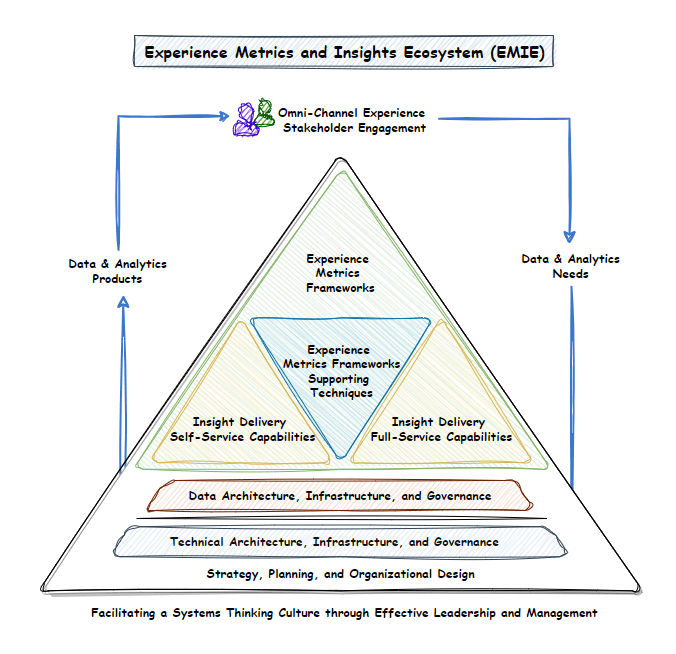
Within this framework, these stakeholders represent individuals or groups with a vested interest or involvement in creating omni-channel experiences. When these groups are not aligned, issues will surface. That said, let’s take a moment to complete an exercise.
Brief Exercise: Take a moment to explore your organization’s online platforms, such as the website and mobile app, and engage with its call center and in-person services. Approach this exercise with a fresh perspective and objectively view the overall customer experience. Pay close attention to subtle details that might go unnoticed, especially if you’re intimately familiar with the processes. For example, you may use your bank’s mobile app to pay a bill. How does that experience differ from when you pay a bill on the bank’s website or at a physical location?
- Did you come across any inconsistencies?
- Did you notice differences in features between different parts of the customer journey?
- When comparing activities like acquiring a new customer and servicing an existing one, were there any disparities that caught your attention?
Engagement, Importance: Drawing from my previous experiences, I’ve uncovered organizational challenges simply by navigating through the digital experience like the previous exercise. A disjointed experience can often indicate internal issues that require further investigation, particularly within large organizations, where the work of hundreds, if not thousands, of individuals, collectively shapes the customer experience. The repercussions become evident in the overall end-to-end customer experience when these teams fail to collaborate effectively. The underlying problem, more often than not, revolves around insufficient engagement among internal stakeholders.
This lack of engagement manifests in many ways such as misalignment in planning and a failure to work toward shared objectives collectively. Communicating challenges, synchronizing leadership efforts, addressing budgetary needs, and avoiding assuming others are already aware of these issues are essential. Engagement across stakeholders is vital to achieve alignment and work collectively towards a seamless customer experience across disparate interactions.
Key Stakeholders: In large organizations, diverse stakeholders are involved in building the omni-channel experience. These stakeholders encompass various roles, including product management, customer experience (CX) analysts, designers (e.g., UX/UI), decision scientists, data scientists, data analysts, data engineers, developers, information governance advisors, information architects, marketing experts, strategy advisors, and more. These roles straddle art and science, showcasing diversity in knowledge and experience. If you’ve had the privilege of working within this environment, you understand it can be incredibly rewarding and complex.
Challenge
Lack of engagement among diverse stakeholders in large organizations responsible for creating omnichannel customer experiences leads to unaligned activities. As a result, inconsistencies, miscommunication, and disjointed efforts undermine the organization’s ability to provide a seamless customer journey.
Symptoms
- Competing priorities create divergent agendas and objectives among stakeholders.
- Measurement and analytics conflicts arise across stakeholders, affecting data collection strategies and insight distribution.
- Resource allocation often poses challenges, particularly in large organizations, where resources must be carefully distributed among numerous projects.
- Consistent communication is hindered among diverse groups, each with unique expertise and terminology, resulting in misunderstandings and alignment issues.
- Technological advancements demand constant adaptability to ensure stakeholders are synchronized and can effectively leverage the latest technology.
These symptoms serve as an initial reference point for gaining insight into the significance and complexities of ineffective stakeholder engagement. Conducting a comprehensive evaluation of your organization’s specific issues and requirements concerning the alignment of stakeholders to deliver seamless omnichannel experiences is crucial. With this in mind, this blog series will address techniques individuals can use to enhance stakeholder engagement effectively.
Final Thoughts – Operational Efficiencies
The “Build Bridges” blog mini-series aims to showcase some techniques to help address challenges with stakeholder engagement. This first blog serves as an introduction, emphasizing the significance of effective stakeholder engagement in driving success and alignment. Alignment is vital to achieve a customer-centric culture. It also helps improve operations by eliminating duplicated tasks, reducing rework, and minimizing unnecessary efforts.
In upcoming blogs, we’ll dive deeper into techniques like Communication Plans, RACI (Responsible, Accountable, Consulted, Informed) matrices, Context Diagrams, Stakeholder Mapping, and Network Mapping, all designed to bring order to the complexities of this space and enhance operational efficiencies.
Stay tuned for more content related to the “Build Bridges” blog mini-series. In the meantime, please share techniques you’ve used to improve stakeholder engagement. Each industry and organization differ, and I am interested in your perspective. You can share your experience within the Comments section.
 Shane M Grizzle
Leave a comment