

by Shane M Grizzle | Updated on September 13, 2023
This blog marks the conclusion of the “The Hip-Pocket Guide for New Team Leaders” series, which emphasizes the role of new team-level leaders, especially those tasked with enhancing omni-channel experiences. Within the Experience Metrics and Insights Ecosystem (EMIE), outlined in the diagram below, culture takes center stage, specifically a culture rooted in systems thinking to elevate the customer experience. This series stresses the significance of team leaders in driving success within this context.
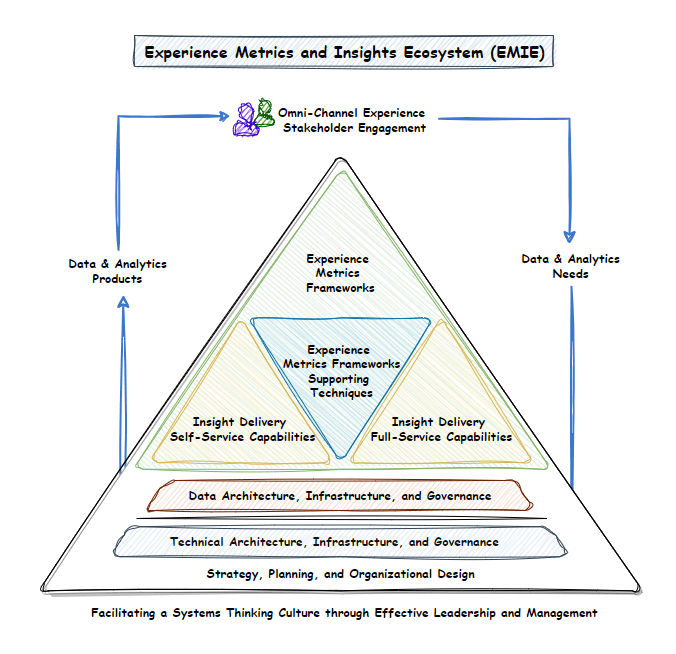
While this blog series targets new team leaders, it’s also essential for seasoned leaders to engage with the content. If you’re a seasoned leader, please share your insights in the comments, subscribe, and pass this blog to aspiring leaders in your network.
Before diving into the timeframe beyond 60 days, let’s briefly revisit what was covered in the previous blogs:
- The Hip-Pocket Guide: First 30 Days for New Team Leaders: In the initial stage of assuming a team-level leadership role in large organizations, leaders might experience unclear expectations, limited support, and the complexities of navigating ambiguity. This critical phase focuses on relationship-building, grasping the operational landscape, and aligning the team with broader organizational goals.
- The Hip-Pocket Guide: First 30 to 60 Days for New Team Leaders: Moving forward, new team leaders transition into deeper relationship-building with key stakeholders. This phase solidifies the connection between the team, its stakeholders, and the products and services offered. During this period, team leaders begin streamlining the team’s prioritization processes, refining existing deliverables, and further developing coaching and mentorship practices.
The previous blogs also summarized the challenges and symptoms of those challenges new team leaders in large organizations face as they transition from an individual contributor role. These aspiring leaders often do not have a comprehensive playbook to kickstart their success to help navigate the ambiguity and complexities of team-level leadership.
With this foundation in place from previous blogs, let’s shift our focus to the period beyond the first 60 days. As a new team leader, it’s time to extend your thinking beyond the immediate tasks. Recall that within the initial 60 days, you solidified your team’s vision, purpose, and value statements. Now, prepared with insights gathered during this timeframe, it’s time to start framing strategies for your team’s path forward.
The Hip-Pocket Guide (Beyond 60 Days)
You, the new team leader in previous blogs, set out to understand the landscape. You built your understanding of stakeholder needs and the direction of your leadership. You also started to shape your team’s focus by establishing its high-level vision, purpose, and value. You refined existing processes to enable projects in flight and built recurring cadences to coach and mentor your team. Now, after 60 days, you need to dedicate more time to shaping the path forward for your team.
Start shaping your team’s culture, developing its roadmap, and working through how individual team members will contribute to delivering what is on your team’s roadmap. Also, it would help to start building well-established cadences and communication channels to highlight your teams’ success and remove impediments. Throughout your post-60-day journey, I recommend considering the following areas to help shape your efforts:
Experimental Mindset: As a new team leader, embracing an experimental mindset is crucial so you can “fail fast.” Adopting a “fail fast” approach allows for quick adjustments and the refinement of tactics and strategies. Leaders must let go of perfectionism while committing to delivering high-quality work. Focus on achieving small wins, experimenting with your team to identify practical approaches, and making necessary adjustments. This mindset is essential in the context of customer experience, and it’s equally as important when developing your team. Suppose you find it challenging to adopt this mindset. In that case, I recommend reading “Little Bets” by Peter Sims, which offers real-world examples of individuals and organizations that thrive by embracing small, experimental “little bets.”
Set, Pause, Ask, Comment, and Encourage (SPACE): Give your team SPACE. You do not need to have all the answers, and you do not need to fill your 1:1s and team meetings as the sole proprietor of communication. For example, in team meetings, set the agenda, and when people are speaking, pause before adding input — actively listen. Proceed to ask a few questions. If there’s silence, add a few comments and encourage others to share their perspective.
Customer-Centric Culture: The concepts shared within this blog aim to empower large organizations to provide a cohesive and integrated customer journey, achieved through unified metrics, supportive techniques, and effective insight delivery. Central to this blog is customer experience. And its bedrock is culture. The EMIE emphasizes adopting a culture rooted in systems thinking, a vital component for delivering a seamless customer experience across various interactions. As a leader operating within this domain, it’s critical that you and your team consistently recognize your interconnectedness with other teams. You understand how your widget may impact other widgets and the customer journey. If you are building an understanding of the customer experience among your team, consider formalized training. There are many programs and literature available. I recommend the Customer Experience Program at the University of Richmond.
Team Roadmap: As the leader, you’ve laid the foundation with your team’s vision, purpose, and value statements. However, now it’s essential to chart the course for turning those aspirations into reality. This effort calls for creating a rolling annual roadmap, a dynamic blueprint that evolves with your goals.
Begin by crafting a comprehensive rolling annual roadmap that outlines how you intend to achieve your team’s vision and purpose. The roadmap should delve into more details in the short term, specifying activities, projects, and milestones for the upcoming quarter or months. This level of granularity ensures a clear path forward in the near-term. Extend the roadmap beyond the immediate future with progressively less detailed plans. Transition from specific tasks to broader initiatives, themes, and objectives as you move further into the future.
Understand that your plan is not set in stone. Be prepared for adjustments and changes along the way. This flexibility is crucial, highlighting the importance of embracing agility and fostering an experimental mindset within your team.
While you can delegate the initial creation of the roadmap, it’s vital for you, as the leader, to actively participate in its development. Regularly revisit and revise the roadmap. Set aside time for periodic assessments and updates to keep it aligned with evolving priorities. Additionally, share the roadmap with your team and stakeholders. Centralize the roadmap in a shared location accessible to all team members. Lastly, establish a cadence for socializing and revising the content of the roadmap.
Team Member Goals: You’re likely familiar with the concept of SMART Goals (Specific, Measurable, Achievable, Relevant, and Time-Bound). You’ve encountered this concept if you’ve been following my previous blog posts. In my experience, leadership often champions SMART goals, but their execution is subpar. I’ve witnessed leaders who pass the responsibility of setting annual goals onto individual team members without intervention, resulting in ambiguity and disconnection. I’ve also seen leaders adopt goals handed down to them from executive management, directly delegating to team members without personalization for their team members when it’s needed. As a leader, it is your responsibility to help establish clear goals for your team members, and the goals need to be personalized and SMART.
Goal setting is a collaborative process between the leader and each team member. While each team member may have professional development goals to enhance their skills, knowledge, and value to the company, as a leader, it’s crucial to understand their aspirations alongside the team’s and organization’s strategic direction. Your task is to align team member goals where possible. For instance, suppose a junior team member seeks to expand their proficiency in SQL, and your team faces the challenge of creating a complex dashboard project. In that case, it’s your responsibility to set goals for a senior member to complete the dashboard while allowing them to mentor the junior member in SQL. This way, the team delivers the dashboard, the senior member gains mentoring experience, and the junior member advances their SQL skills. As a leader, you must connect the dots for individual team members.
Highlighting Success: As a leader, allocating time for effectively showcasing your team’s successes and removing barriers is imperative. Develop a plan for incrementally communicating successes to your manager and higher-ups throughout the year (e.g., weekly, biweekly). While doing so, highlight specific barriers that need intervention (i.e., those beyond your influence) and how they impact performance. Roll up your incremental success as more significant wins within quarterly and annual reports. Recognize the moments when a presentation to management is pivotal to emphasize a substantial team victory or considerable barrier.
Internally, it’s equally important to establish a system for highlighting successes within your team, even if they involve a team member’s professional development achievements or the evolution of “little bets” into significant gains. Recognizing and celebrating small wins can boost morale, foster active employee engagement, and strengthen camaraderie among team members.
Consider developing a communication plan for these activities. Within the plan, identify the audience, the communication method, topics covered (e.g., quarterly accomplishments), and when the communication needs to be disseminated.
As a leader, also take the time to document your journey in facilitating your team’s success. Capture specific projects’ challenges, your problem-solving approach, and the ultimate outcomes achieved. Document the leadership and team obstacles encountered along the way and the tactics you deployed to navigate them. This documentation serves a dual purpose: it facilitates self-reflection and adjustment while enabling you to articulate your growth and achievements as a leader effectively. Do this monthly and block the time on your calendar (~ 1 Hour).
If you’ve established effective SMART Goals for you and your team, highlighting success is easier!
Final Thoughts – Operational Efficiencies
This blog encourages an experimental mindset, and “failing fast” is emphasized as a critical strategy, allowing leaders to make quick adjustments and prioritize high-quality work while achieving small wins. Cultivating a customer-centric culture within the Experience Metrics and Insights Ecosystem (EMIE) framework was highlighted, stressing the interconnectedness of teams and the importance of understanding the impact of individual contributions on the overall customer journey. The bog stressed the need for personalized SMART goals for team members, emphasizing the role of leadership in aligning personal aspirations with the organization’s strategic direction. Additionally, the importance of effectively highlighting team success and removing barriers is underscored internally and externally to the team, with the recommendation to document leadership achievements regularly.
The content outlined within this blog includes some professional observations of techniques that have worked for me. However, it’s essential to remain flexible as a leader. Your environment or leadership style might require a different approach, which is okay.
This blog concludes “The Hip-Pocket Guide for New Team Leaders” series, which served to help people as they transition from an individual contributor role to a team leader. Remember, team leaders form the backbone of large organizations, especially in the intricate landscape of interconnected customer experiences. In addition, operational efficiencies are the key to unlocking success, and it all starts with you – the new team leader.
 Shane M Grizzle
Leave a comment