
by Shane M Grizzle | Updated on August 10, 2023
Many years ago, I met with a group of executives to present the progress of some significant initiatives I was leading. Among those executives was the second-in-command. The meeting went smoothly, and as we were wrapping up, this individual asked me: ‘So… what’s your story?’
Chances are, as a reader of this blog, you might have found yourself in similar situations. At that moment, I improvised my response, and surprisingly, it turned out well – at least, I think it did, as I was invited to more meetings with this executive. However, reflecting on the encounter, I wasn’t prepared to effectively advocate my or my team’s vision, purpose, and value proposition. These statements are, in essence, you and your team members’ elevator pitches, advocating for your team’s existence.
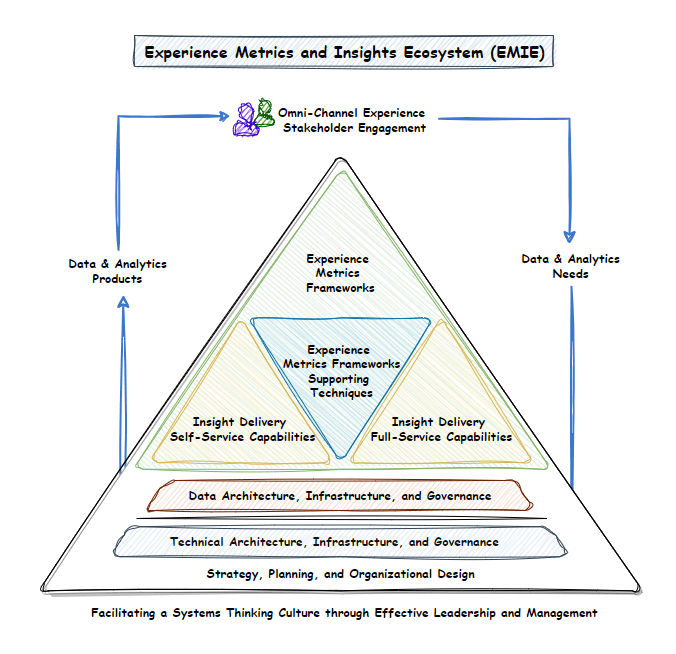
Team-level leadership has been a focal point of my blog over the last week and will continue to be a focal point for a few more weeks. Effective team leaders are the backbone of the corporate world, so I am investing time in the topic and its relationship to Experience Metrics and Insights Ecosystem (EMIE). Although vision, purpose, and value proposition are fundamental principles in business, from my personal perspective, leadership at the departmental and team levels often lack effectiveness in this domain.
Foundational aspects of the EMIE is Strategy, Planning, and Organizational Design, in addition to Leadership and Management. These aspects ensure alignment and underscores the importance of planning to synchronize all stakeholders and facilitate a system-thinking culture. I have found success initiating these efforts by communicating a clear and thoughtful vision, purpose, and value proposition statements. These statements are not limited to executive management. They must be embraced and utilized across all levels, including team-level leaders.
Challenge
Departments, teams, and individuals often experience significant challenges without a well-defined vision, purpose, and value proposition. These statements are necessary for improving strategic alignment and communication across all levels. The absence of these statements results in a lack of direction, weak employee engagement, and difficulties in attracting top talent. Additionally, decision-making processes become less cohesive, and the organization struggles to maintain a unified culture.
Symptoms
- Unclear expectations cause employees to misunderstand long-term objectives, resulting in confusion, disengagement, and unpreparedness.
- Decreased motivation and engagement as employees do not have a sense of purpose, feeling disconnected from driving meaningful results.
- Misalignment across team members regarding the overall purpose and objectives, leading to different priorities, conflicting efforts, and ineffective collaboration.
- Lack of accountability due to misunderstanding roles and responsibilities, consequently impacting deliverables and ownership of work.
- High turnover rates as employees need a sense of purpose and shared values, resulting in feeling disconnected and interest in other opportunities.
While I have only listed five symptoms, the lack of clear vision, purpose, and value proposition statements for teams can lead to numerous issues in a large organization.
Solution Consideration – Vision, Purpose, and Value Proposition Statements
The ecosystem that delivers the Omni-Channel Experience wrestles with transformation. Situational leadership plays a key role, tailoring approaches based on team missions and maturity. However, transformational and servant leadership are the core pillars, supporting continuous evolution as teams need inspiration toward a vision and sufficient support and empowerment. Therefore, crafting vision, purpose, and value proposition statements is essential to inspire and align teams toward success. Leaders must take ownership and accountability for this task to drive meaningful transformation and employee confidence.
Your Vision, Purpose and Value Proposition Statements: To level-set on the statements, here’s a brief definition:
- Vision describes what you aim to achieve.
- Purpose explains why you exist.
- Value proposition addresses why you are essential.
It’s vital to ensure both vertical and horizontal alignment of these statements. Vertical alignment means harmonizing them at different hierarchical levels, from the overall company to the team vision. Horizontal alignment ensures consistency across other functional areas, reinforcing unity. To stress this point, those employees operating within a company to deliver the Omni-Channel Experience do not dwell within a two-dimensional state, as depicted in the visualization below.
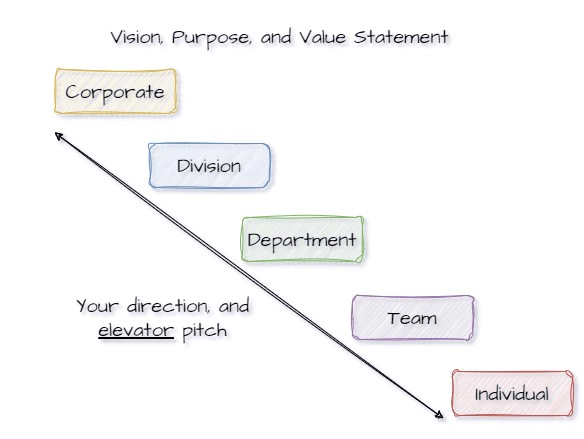
Instead, the nature of developing vision, purpose, and value proposition statements is attributed to the many relationships these employees must navigate and align. These employees encompass various roles, including product managers, IT, data scientists, designers, and more. To effectively communicate what you aim to achieve, why you exist, and why you are essential in this complex environment, seeking alignment across various levels of your organization is crucial, as depicted in the visualization below.
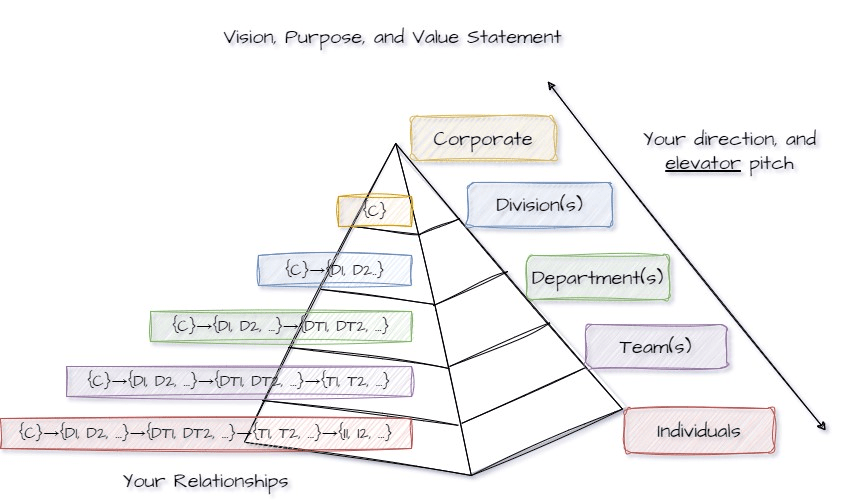
In this interconnected landscape, crafting these statements requires consideration and coordination across different hierarchical layers, from the overarching company level to divisions, departments, teams, and individual contributors. The significance lies in achieving unity and purpose that drives successful transformation within your organization. Additionally, once complete, your employees will be equipped with an extremely powerful elevator pitch that will fuel confidence and engagement, and your message as a leader will spread like wildfire as their relationships are many. The following includes some guidance:
The Problem: Before you have a vision, purpose, or value proposition, you must understand the problem you are addressing. This blog article does not delve into problem statements. I’ll write a separate blog about this topic. However, you must address a solution that solves a problem, and you must invest time with your leadership and team to pinpoint your problem statement (i.e., opportunity).
Your Value Proposition: Develop an understanding of your customer. Who will benefit from solving the problem? Various techniques can help structure the identification of customers (personas, empathy maps, etc.), a topic I will address in more detail in another blog. In doing so, you can better understand the value you are delivering. And it would help if you quantified that value through meaningful metrics. You need to measure your team’s performance; therefore, spend time understanding your value proposition and how you will measure progress.
Your Vision: Once you understand the problem and the value you are providing, you can envision the target state. This vision should be a clear, high-level statement. Share the true “north star” that inspires partners, customers, and your team(s). Your team should tackle a complex problem requiring sustained effort over multiple years. Therefore, it’s essential to envision what the desired state will look like at that point in the future. This forward-looking perspective ensures that your team focuses on a long-term goal that will guide your efforts throughout its journey.
Your Purpose: With a comprehensive understanding of the problem, customer, value proposition, and target state, it’s crucial to clarify where your team fits into this picture. How will your team contribute to changing the landscape and improving the current situation? Recognize that your problem will likely involve a multi-year journey. You don’t need to provide specific solutions when drafting your purpose statement. Instead, focus on articulating how your team can help solve the overarching problem, iteratively moving toward the envisioned target state.
Who’s Involved: This effort cannot be completed in isolation. As a leader, your role involves fostering brainstorming sessions involving your team, partners, and management to achieve alignment. It’s natural for divergent opinions to arise during these discussions. Your role is to facilitate these discussions, helping the group work through semantic differences and varying viewpoints, ultimately arriving at concise statements that resonate with everyone involved. This process may require a single engagement or several. The time invested in this process will yield significant benefits by establishing clear expectations, enhancing employee engagement, aligning disparate efforts, and setting a tone of accountability.
Your Elevator Pitch: Most of us are familiar with the concept of an elevator pitch. If you’re not, imagine being in an elevator where you can make a lasting impression before everyone exits on the next floor. The goal is to succinctly communicate your vision, purpose, and the value you bring. However, this scenario is not limited to elevators; it occurs in various situations like casual networking, meetings, lunch, and more. As a leader, you must empower employees with the confidence and content they need to deliver these pitches effectively. Likewise, as an employee, you can play a crucial role in helping your leaders craft these impactful statements. Remember, you’re all part of a team, and representing your team well requires collaboration.
When employees clearly understand their vision, purpose, and value proposition within their specific roles (i.e., their ‘swim lane’), it improves communication and better socialization among peers. As a result, employees gain insights into each other’s areas and establish more substantial alignment and accountability within the organization while fueling motivation across teams. Investing time and effort crafting a well-defined vision, purpose, and value proposition statement will yield substantial returns in enhanced productivity, collaboration, and overall success.
Elevator Pitch Example Structure:
Purpose, Problem, Customer, Value, Vision, Call to Action
“I provide [Purpose] to address [Problem] for [Customer]. In doing so, we provide [Value]. Our goal is to achieve [Vision]. I’d be more than happy to [Call to Action*].
*Ask for another touchpoint as an opportunity to expand upon your elevator pitch.
Final Thoughts – Operational Efficiencies
Remember, the EMIE stresses a culture that embraces systems thinking. Therefore, alignment is critical as it builds an understanding of the interconnections across various domains. Vision, purpose, and value proposition statements help foster alignment, will motivate others, and serve as a compelling elevator pitch at multiple settings.
As a team leader, seek to establish these statements. This effort is collaborative and should include your team and partners. Ensure that your statements align vertically to your leader and horizontally to partners. And once finished, make sure your team is ready to echo those statements during their engagements. If you are still determining where to start, ask your team members during one-on-ones for an elevator pitch regarding their team. If their pitches are inconsistent and they fumble through their response, or it takes longer than an elevator ride, then you, as a leader, have work to do. This result isn’t a reflection on your team members – it’s a reflection on your leadership.
This blog provides one potential solution based on my professional observations. Consider the principles of situational leadership, as discussed earlier in this blog. Other leaders may have different approaches that suit their unique contexts and preferences. The critical takeaway is to empower your team members to express their impact within the organization compellingly and concisely. The path you choose to achieve this goal may vary, and it’s essential to tailor the approach to fit your team’s specific needs.
If you have been reading my blogs, recently, I have focused on Facilitating a Systems Thinking Culture through Effective Leadership and Management. For example, I wrote about, The Hip-Pocket Guide: First 30 Days for New Team Leaders and Fostering Success: Improving Teams through Team Charters. The vision, purpose, and value proposition statement topic will provide a segue from these blog articles to the next one, covering 30 to 60 days for new team leaders. Stay tuned for updates.
 Shane M Grizzle
Leave a comment