

by Shane M Grizzle | Updated on June 18, 2023
The Omni-Channel Experience should be a cohesive and integrated customer journey that seamlessly connects various interactions and channels, ensuring customers can consistently engage with a brand or business across different touchpoints. By delivering a unified experience across mobile, desktop, in-person, and beyond, companies can effectively meet customer expectations, fostering brand loyalty and driving repeat business. In today’s dynamic marketplace, channel-agnostic customer experiences form the foundation for sustained success and a competitive edge.
However, achieving this level of integration is complex, particularly for large companies with extensive workforces. Operational inefficiencies, bureaucratic hurdles, leadership and management issues, and unnecessary processes impede progress. Moreover, the pursuit of becoming more data-driven can inadvertently lead independent departments within large companies to adopt fragmented approaches, losing sight of the holistic experience. Thus, organizational silos result in conflicting business objectives, divergent metrics, and disjointed data collection efforts.
To address these challenges and elevate the Omni-Channel Experience, large companies must embrace a data-driven culture that focuses on delivering experience metrics and insights that drive tangible results and alignment. The culture must emphasize cross-functional collaboration and systems thinking, addressing the holistic customer experience.
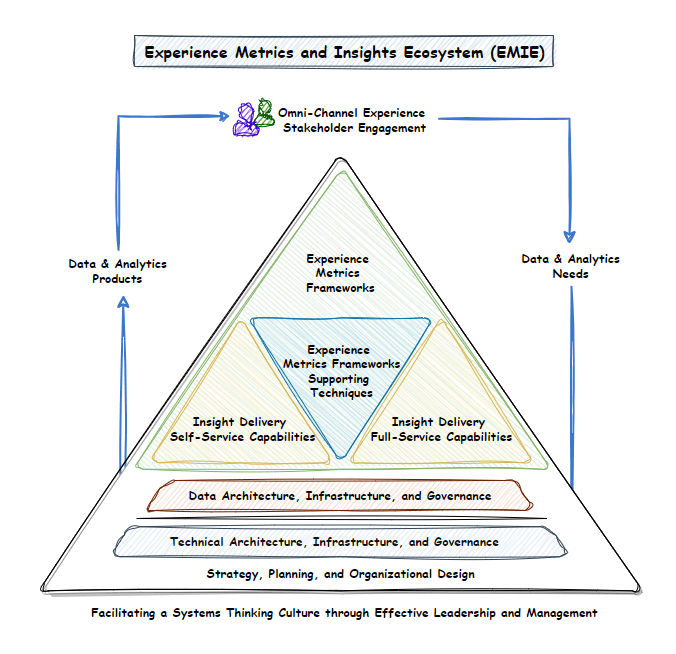
This blog will expand upon the brief introduction of the conceptual framework, Experience Metrics and Insights Ecosystem (EMIE), that is located in my About section. Later, blogs will delve into various topics under each section of the ecosystem, sharing my professional observations.
Challenge
Delivering a cohesive and integrated Omni-Channel Experience in large organizations presents a complex challenge. Various departments, teams, and individuals with distinct expertise (e.g., decision science, product management, design, etc.) are often responsible for different aspects of the customer journey. These organizational silos often hinder alignment, exacerbating issues with disparate efforts, conflicting objectives, and isolated analysis of related data and analytics. Overcoming these barriers requires a unified and collaborative approach, enabling organizations to break down silos, align efforts, and leverage a holistic, data-driven, culture to optimize customer experiences and achieve sustained success across all channels.
Symptoms
- Inconsistent customer experiences exist within and across channels, impacting customer interactions and leading to customer confusion and reduced satisfaction.
- Fragmented data and insights limit end-to-end experience analysis across channels (e.g., mobile, phone, contact center).
- Conflicting objectives, key performance indicators, and metrics across stakeholders leading to competing priorities that hinder creating a seamless customer experience.
- Duplication of efforts impact departments and teams resulting in misaligned solutions, wasted resources, and inefficiencies.
- Inefficient decision-making as leaders have undefined swim lanes, which can also increase the likelihood of departments and teams competing against one another.
- Missed opportunities from isolated analysis of data and analytics, preventing the identification of broader opportunities for improvement holistically.
Solution Consideration – Experience Metrics and Insights Ecosystem
The Experience Metrics and Insights Ecosystem (EMIE) addresses the challenge of delivering a cohesive and integrated Omni-Channel Experience in large organizations. At its core, EMIE emphasizes the need for cross-functional collaboration and systems thinking. It recognizes that various departments, teams, and individuals within an organization play crucial roles in shaping different aspects of the customer journey. By fostering alignment, EMIE ensures diverse expertise work harmoniously, creating a seamless and unified customer experience across all channels.
EMIE also highlights the importance of establishing a unified metrics framework, which encourages synchronization across personnel, anchoring on standard metrics to improve. The unified metrics framework aids insight delivery by focusing on the most critical reporting needs. By setting consistent and standardized metrics, companies consistently evaluate customer experience success. This approach ensures everyone in the organization is working towards a common set of goals, eliminating conflicting objectives and duplication of efforts.
EMIE is the foundation for subsequent blogs, highlighting various topics for discussion. However, below is a high-level overview of each topic. Note that the blog previously published, Unlocking Operational Harmony: Introducing Experience Metrics Trees in Experience Metrics Frameworks, covers a high-level overview of Experience Metrics Frameworks and Supporting Techniques. Some of that content is in this blog to reference more easily.
Omni-Channel Experience Stakeholders: Key internal stakeholders within the company are instrumental in shaping, delivering, and analyzing customer experiences. These stakeholders encompass various roles, including product managers, product owners, decision and data scientists, data engineers, designers, and more. They actively participate in specifying data and analytics requirements, developing data and analytics products, and leveraging related insights to make informed decisions that enhance and optimize the overall customer experience.
Experience Metrics Frameworks: Encompass an organization’s broader approach to measuring, evaluating, and improving customer experiences. Examples of the frameworks include Google HEART and the Customer Experience (CX) Maturity Model. Additionally, frameworks like North Star and Objective and Key Result (OKR) are effectively utilized within the realm of experience. Experience Metrics Frameworks provide a systematic and structured methodology for collecting, analyzing, and interpreting data, ensuring consistency in measuring customer experiences across different teams and departments.
Experience Metrics Frameworks Supporting Techniques: Addresses various methodologies and tools utilized to measure, evaluate, and analyze different aspects of customer experiences. These techniques support the implementation and adaptation of Experience Metrics Frameworks and play a vital role in aiding the development of insight delivery capabilities. Examples of these techniques include Customer Journey Mapping, Usability Testing, Metrics Trees, and Net Promoter Score. These techniques support the analysis of various metrics defined within the chosen framework while informing the creation of self-service capabilities, such as internal publications and dashboards.
Insight Delivery (Self-Service and Full-Service Capabilities): This section underscores the significance of both self-service and full-service capabilities. Companies must prioritize streamlined and user-friendly self-service options to avoid falling into the trap of dashboard factories burdened by unnecessary technical debt and misuse by inadequately trained users. It is equally important for full-service capabilities to be equipped with skilled experts who can deliver actionable recommendations. Expert analysts in this domain should go beyond data analysis to deliver practical insights that guide experience enhancement and optimization decision-making.
Data Architecture, Infrastructure, and Governance: In the context of large companies, the abundance of data, particularly concerning the customer experience, necessitates a robust focus on data architecture, infrastructure, and governance. Striking the right balance in this section is crucial, as more than just emphasizing governance can stifle knowledge sharing, hindering innovation. Conversely, excessive democratization without proper governance can lead to conflicting measurement methodologies, compromised data quality, and a counterproductive environment where experts duplicate data extraction, manipulation, reporting, and analysis efforts. Therefore, a well-designed data architecture, infrastructure, and effective governance practices are essential for the ecosystem to run smoothly.
Technology Architecture, Infrastructure, and Governance: Supports the entire ecosystem, such as defining application integrations and selecting suitable Software as a Service (SaaS), Platform as a Service (PaaS), and Infrastructure as a Service (IaaS) solutions. Examples include client-side analytics tools (e.g., Adobe Analytics) and tag management systems (e.g., Tealium). Beyond its foundational significance, this section assumes a vital governance role such as overseeing the supporting systems and preventing the adoption of redundant solutions within the tech stack.
Strategy, Planning, and Organizational Design: This section highlights the significance of continuous alignment of the ecosystem efforts with corporate, business, and functional strategies, emphasizing the need for careful planning to synchronize all stakeholders across the roles specified in this blog. Organizational design plays a crucial role in this context, as it sets the foundation for effective collaboration among the diverse experts shaping the Omni-Channel Experience. Understanding the organizational structure, communication channels, workflows, processes, roles, and responsibilities is imperative for these experts to navigate their work environment.
Systems Thinking and Leadership and Management: Beyond the larger triangle is leadership and management, emphasizing systems thinking culture. In shaping the Omni-Channel Experience, a diverse range of leaders play pivotal roles. For example, on one end, technical leaders focus on data movement, while on the other, highly skilled designers contribute to creative deliverables. Effective leadership and management are vital for success, requiring a deep understanding and promotion of systems thinking. Everyone must recognize the intricate interconnections across the customer experience, understanding that even the slightest tweak to a widget could affect other widgets, workflows, or micro experiences elsewhere.
Final Thoughts – Operational Efficiencies
In conclusion, the Experience Metrics and Insights Ecosystem (EMIE) sheds light on the intricacies of achieving a genuine Omni-Channel Experience. EMIE underscores the imperative for large companies to embrace a data-driven approach, focusing on delivering experience metrics and insights that yield tangible results and foster alignment. The framework emphasizes cross-functional collaboration and systems thinking, effectively addressing the holistic customer experience. Through the visualization of EMIE, stakeholders gain valuable awareness of the significance of data-driven solutions and the need to consider the experience and related operations holistically.
This blog introduces the conceptual framework, EMIE, which will lay the groundwork for subsequent blogs. However, for now, consider how your organization interacts with internal stakeholders who influence customer experiences. Are there opportunities to build relationships and improve collaboration? Assess the metrics leveraged to comprehend changes in customer experiences and how they interconnect throughout the customer journey. Familiarize yourself with the data and technical architecture, strategy, and governance that support the evolution of the customer journey. Align your customer experience initiatives to corporate, business, and functional strategies. Lastly, as a leader, foster a culture of systems thinking, encouraging a broader perspective and cohesive understanding among your team.
 Shane M Grizzle
Leave a comment